
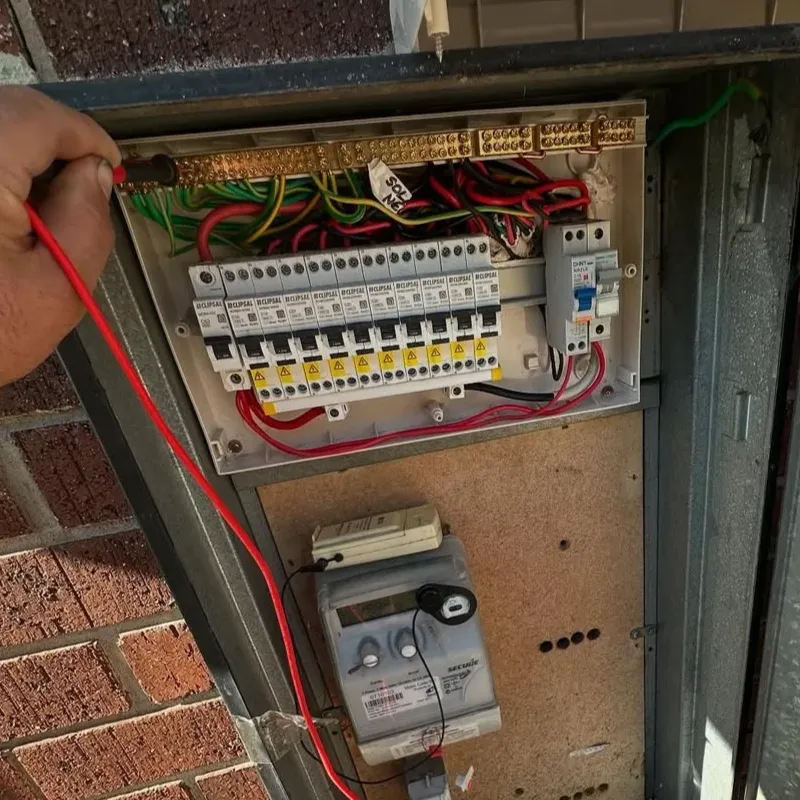

A switchboard upgrade in Melbourne typically costs $1,500- $3,500 for a full replacement, depending on your home’s size and the complexity of your electrical system. Three-phase systems or larger homes can push that figure to $5,000 or more.
It is not the most glamorous home improvement, but a switchboard upgrade is one of the most important you can make for your household’s safety. Your electrical switchboard is the backbone of your home’s electrical system, and an outdated switchboard is a genuine fire and electrocution risk.
If your home still has ceramic or rewirable fuses or no safety switches, your switchboard is overdue for an upgrade. Old switchboards pose real electrical hazards, and Australian electrical standards have moved well beyond the technology found in pre-1990s Melbourne homes.
Here is a complete 2025 guide to switchboard upgrade costs in Melbourne – what you will pay, what drives the price, and what the process involves.
Switchboard Upgrade Cost Summary
The table below shows typical switchboard upgrade costs in Melbourne (inc. GST). Prices include standard Clipsal, Hager or NHP switchboard enclosures and components.
| Service | Typical Cost (inc. GST) |
| Switchboard upgrade – standard home, single phase | $1,500 – $2,500 |
| Switchboard upgrade – larger home, many circuits | $2,500 – $3,500 |
| Switchboard upgrade – 3-phase supply | $3,000 – $5,000 |
| Add RCD safety switch to existing board (per RCD) | $250 – $400 |
| Add circuit breaker (per breaker) | $150 – $250 |
| Switchboard relocation | $2,500 – $5,000+ |
| Sub-board installation (shed, granny flat) | $800 – $1,500 |
| Mains upgrade – if required, via distributor | $500 – $2,000+ (distributor fees vary) |
Contact a licensed electrician for a free fixed-price quote tailored to your home and current electrical demands.
What Is an Electrical Switchboard Upgrade?
Your electrical switchboard – also called a distribution board, fuse box, or electrical panel – is the main switchboard that distributes electrical current from the mains supply to every circuit in your home. It also provides protection against overload, short circuits, and electrical leakage.
An electrical switchboard upgrade replaces your old switchboard with a modern unit. A new switchboard contains three key components:
- Main switch – a single point to cut all power to the house
- Circuit breakers – these replace old fuses and automatically trip when a circuit is overloaded, protecting against electrical fires
- RCD safety switches (Residual Current Devices) – these detect earth faults and cut power within 30 milliseconds, fast enough to prevent electrocution in most cases
The progression of switchboard technology in Australian homes is as follows: ceramic fuses (pre-1960s) – rewirable fuses (1960s-1980s) – old circuit breakers without RCDs (1980s-1990s) – modern switchboards with RCDs on all circuits (current standard).
If your home still has ceramic fuses or rewirable fuses, you are operating well below the current minimum standard. Outdated switchboards pose a real and unnecessary risk to your household.
Signs Your Outdated Switchboard Needs Upgrading
Visual Warning Signs
- Ceramic fuses – round, white porcelain fuse holders – pre-1960s technology
- Rewireable fuses – bakelite fuse holders with fuse wire – common in 1960s-1980s Melbourne homes
- Burn marks, discolouration or melted plastic on the existing switchboard
- Exposed wiring or missing covers on the board
- Asbestos backing board – found in many older Melbourne switchboards, and a serious electrical hazard
Functional Warning Signs
- Fuses blowing or circuit breakers tripping frequently – a sign of overload on your current electrical demands
- Lights flicker when modern appliances switch on
- No safety switches installed – outdated switchboards without RCDs leave your household unprotected
- Too few circuits for your home’s power demands – everything running off two or three circuits
- No spare positions on the board for any new circuit additions
Compliance Triggers
- Selling or renting the property – RCDs are a legal requirement for rental properties in Victoria
- Home renovation – kitchen, bathroom, or extension work often requires electrical compliance
- Installing high-draw modern appliances – induction cooktops, EV chargers, or split system air conditioning
- An insurance company or electrical inspector requesting a safety assessment
If any of the above apply, an electrical switchboard upgrade is not optional; it is a matter of safety and compliance with Australian electrical standards.
What Affects the Cost of a Switchboard Upgrade in Melbourne?
No two switchboard upgrade projects are identical. Here are the key factors that will influence your decision to invest in a switchboard upgrade.
Size of the Home and Number of Circuits
The number of circuits is the single biggest cost driver. A standard switchboard upgrade for a small home (two bedrooms, six to ten circuits) sits at the lower end of the price range. A medium home (three to four bedrooms, 12 to 18 circuits) falls in the mid-range. Larger homes (five or more bedrooms, 20-plus circuits) will be at the upper end.
Single Phase vs Three Phase
Most Melbourne homes run on single-phase power – the standard configuration. Some larger homes or properties with workshops and heavy electrical equipment have a three-phase supply. A three-phase switchboard upgrade is more complex and costs $3,000 to $5,000.
Condition of Existing Wiring
If the existing electrical wiring is in good condition, it connects to the new board without issue. If the wiring has deteriorated, is damaged, or uses aluminium conductors – common in some 1970s Melbourne homes – additional electrical work will be required. An electrical inspector or your licensed electrician will assess this during the quote.
Asbestos backing boards on old switchboards must be removed by a licensed asbestos removalist before any electrical work can begin. This cost is separate from the switchboard upgrade service itself.
Mains Supply Capacity
Older Melbourne homes may have a 40A or 63A mains supply. Modern electrical requirements typically call for 80A-100A. If the mains supply needs upgrading, your electrician will coordinate with AusNet Services, but the distributor will charge its own fees in addition to standard labour rates.
Location of the Existing Switchboard
If the switchboard stays in its current position, pricing is standard. If relocation is needed – for example, the board sits inside a cupboard being renovated or does not meet current electrical codes – this adds significantly to the switchboard upgrade project cost.
RCD Safety Switches – Why They Are an Electrical Safety Standard
Residual Current Devices (RCDs) are the most critical safety feature in modern electrical switchboards. An RCD detects electrical leakage – for example, a person touching a live wire or a faulty appliance sending current through an unintended path – and cuts power within 30 milliseconds. This is fast enough to prevent electrocution in most cases.
Under AS/NZS 3000:2018, the Australian standard for electrical wiring, all power point circuits must be protected by RCDs. In Victoria, the requirement goes further – switchboards in rental properties must have safety switches covering all power and lighting circuits.
Without RCDs, your family has no protection from the most common cause of electrical fatality in Australian homes. If your existing switchboard is 20 or 30 years old and predates current electrical safety standards, there is a strong likelihood it lacks adequate protection. Switchboard upgrades are essential wherever RCD protection is absent or incomplete.
The Switchboard Upgrade Process – Step by Step
Here is what a standard switchboard upgrade service with Statewide Sparkies involves:
- Assessment – your licensed electrician inspects the existing switchboard, electrical wiring, and mains supply to identify what needs replacing and whether any additional electrical work is required.
- Quote – a fixed-price quote is provided covering the full scope of work.
- Scheduling – same-day service is available if you call before midday. Otherwise, a scheduled date is confirmed.
- Power disconnection – power is turned off at the mains for the duration of the upgrade, typically four to six hours.
- Old board removal – the outdated switchboard is removed. If an asbestos-backed board is present, a licensed removalist handles it separately.
- New board installation – the modern switchboard is mounted, all circuits are transferred, and new circuit breakers and RCDs are installed in accordance with current Australian standards.
- Testing – every circuit is tested for correct operation. RCDs are tested to confirm they trip within specification under Australian electrical standards.
- Certificate of Electrical Safety (COES) issued – as required by Victorian law.
- Power restored – your home’s electrical system is back up and running, usually by the end of the day.
Save Money: Bundle Your Switchboard Upgrade with Other Electrical Work
If you are planning a kitchen renovation, downlight installation, or new air conditioning, bundle the electrical work together. A switchboard upgrade carried out alongside other electrical services costs less overall than booking two separate jobs – your electrician is already on site, the power is already off, and the new switchboard will have spare capacity for the additional circuits from day one.
Electrical services commonly associated with a switchboard upgrade include downlight installation, kitchen electrical work, ceiling fan installation, and split-system air conditioning.
Common Questions About Switchboard Upgrade Costs in Melbourne
How much does a switchboard upgrade cost in Melbourne?
A standard single-phase switchboard typically costs $1,500 to $3,500. Larger homes or three-phase systems are $3,000 to $5,000. Contact us for a free quote.
How long does a switchboard upgrade take?
Typically, four to six hours for a standard domestic switchboard. Your power will be off during this time. Most jobs are completed within a single day.
Do I need a switchboard upgrade for a rental property?
If the property does not have RCD safety switches on all power and lighting circuits, yes – Victorian law requires this. It is a legal requirement, not a recommendation.
Will I need a switchboard upgrade to install an induction cooktop?
Possibly. An induction cooktop needs a dedicated 32A circuit. If your current board has no spare positions, a switchboard replacement or sub-board installation will be required.
Can I just add an RCD without upgrading the whole switchboard?
Sometimes, if the existing switchboard has available space and is otherwise in good condition. However, if the board has ceramic fuses or rewirable fuses, a full upgrade is the safer and more cost-effective path. Attempting DIY electrical work on a switchboard is illegal in Victoria and extremely dangerous.
Do you remove asbestos from old switchboards?
Asbestos removal requires a licensed asbestos removalist. We coordinate this as part of the process. The asbestos removal cost is separate from the electrical work.
What brands do you use?
We use Clipsal, Hager and NHP switchboard enclosures and components – trusted Australian-market brands backed by manufacturer warranties and our lifetime guarantee on workmanship.
Ready to Book? Get a Free Switchboard Inspection and Quote
Unsure if your switchboard needs upgrading?
Call Statewide Sparkies on 0435 877 448 for a free switchboard inspection and quote. We will tell you whether you need an upgrade – and if you do not, we will tell you that too. No hard sell. No hidden costs.
Licensed (REC 25170) – Lifetime Warranty on Workmanship – 5.0 Stars on Google (82 Reviews)
Call: 0435 877 448
Email: jay@statewidesparkies.com.au
Web: statewidesparkies.com.au