
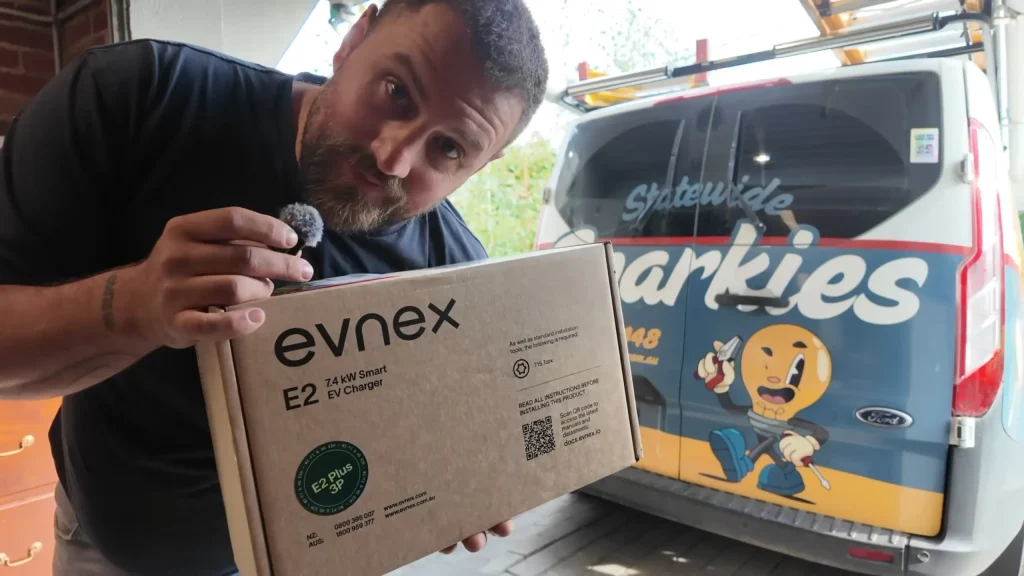

By Jay – Owner and Electrician, Statewide Sparkies | Melbourne’s North
You’ve just spent $60,000 on an electric vehicle. The last thing you want is to bolt a charger to the wall and regret it six months later.
As an electrician who’s installed hundreds of EV chargers across Melbourne’s north, I get the same questions every week. So here’s everything you need to know before you call anyone for a quote – including what to say when you do.
Prefer to watch rather than read? I cover all of this in the video here.
Dumb Charger vs. Smart Charger: What’s the Difference?
Every charger on the market today falls into one of two categories.
A dumb charger does one thing: it draws as much power as possible, as fast as possible. The moment you plug in, it tries to pull the full load – typically 32 amps. If your home only has a 40-amp main switch (which is extremely common in Melbourne), you’ll trip it. The lights go out. The oven dies. And you’re now rationing power just to charge your car.
Some people work around this by setting schedules. But if you drive a lot, forget once, or leave the heater running overnight, you’re back to the same problem.
A smart charger watches what your house is already using and fills the gap. Your electrician programs in your main switch rating during setup. From that point on, the charger knows your limit and never crosses it. When the kids go to bed, the oven cools down, and the TV switches off – the charger quietly picks up that slack and charges your car faster. No schedules. No thinking. No tripped fuses.
That’s what you’re paying for with a smart charger. The guarantee that it just works.
The Solar Angle Nobody Talks About
Here’s where smart chargers really earn their keep.
If you have solar panels, you’re probably feeding excess energy back to the grid during the day for somewhere around 0.1 cents per kilowatt hour. That’s basically nothing.
A smart charger can redirect that surplus straight into your car instead. Free fuel. Every sunny day. If you work from home, or your car sits in the driveway during daylight hours, the charger can be set to charge exclusively from excess solar – so you’re never paying to top up the battery.
Now consider the price gap between a dumb charger and a smart one. It’s around $150 to $200. If you have solar, you’ll recover that in free energy long before the year is out. For most people, a smart charger is the obvious choice.
What Kilowatt Rating Do You Actually Need?
Most home chargers come in three flavours:
- 7 or 7.4 kW – single-phase, 32 amps
- 11 kW – three-phase, 20 amps
- 22 kW – three-phase, 32 amps
For 99% of homeowners, the 7.4 kW single-phase charger is all you need. It charges most EVs overnight without issue. The 22 kW option is for high-usage situations – think someone driving 400 km a day who needs a full charge every single night regardless of the season.
Don’t let anyone upsell you to a three-phase charger unless your usage genuinely demands it.
Three Questions to Ask Before You Call an Electrician
Before you pick up the phone, have answers to these ready. A good electrician will ask all of them – and they’re not trying to upsell you, they need this information to quote you accurately.
1. What car do you have?
Different vehicles have different compatibility. Tesla, for example, has specific integrations with certain charger brands that aren’t available across the board. Some chargers let you tap a button and the charge port opens automatically – others don’t. Know your car before you shop for a charger.
2. What’s your home setup?
Single storey or double? Tin roof or tiles? These questions affect how long the cable run takes and what access looks like inside your roof space. It’s not small talk – it directly affects the quote.
3. Single phase or three phase?
Go look at your switchboard. Find the main switch. It’ll have a label that starts with “C” followed by a number: C32, C40, C50, or C63. That number tells you how much power your home can draw.
Single-phase main switches are about 1 cm wide with one toggle. Three-phase are roughly 3 cm wide with a broader body and three distinct contact points.
Also, how old is your switchboard? If it hasn’t been touched in years, an electrician needs to know before adding a significant new load to it. That’s not a conversation designed to sell you a switchboard upgrade – it’s basic due diligence.
Which Charger Is Right for Your Situation?
Here are the three scenarios I walk most customers through:
You don’t have solar and you’re not planning on it
Go with something like the EV-X Flex. It’s a solid smart charger, handles load management, and you won’t pay for solar capabilities you’ll never use.
You’re planning to get solar, or you already have it
Look at the EV-NX E2 Core. It handles solar surplus charging, load management, and works with most vehicles on the market. It’s the charger I recommend most often.
You have solar, a Tesla, need a long cable, and want every feature available
The EV-NX E2 Plus is built for you. It has Tesla integration (the charge port opens from the charger), handles three-phase installs, and supports untethered setups where you can add an 8-metre cable if your car parks further from the wall.
What to Say When You Call for a Quote
The cleaner the information you give, the more accurate the quote you’ll get. Here’s a simple script:
“Hi, I’m looking to get an EV charger installed. I drive a [make and model]. I [do/don’t] have solar. My switchboard was upgraded [recently/more than 10 years ago]. I’ll send you a photo of it. The charger would go about [X] metres from the switchboard. It’s a single-storey [tiled/tin] roof property. Here’s my address.”
That’s it. A good electrician can often get you a fixed-price quote from that alone – especially if you send a photo of your switchboard and the wall where you want the charger to go.
One Last Thing About the Budget Option
You’ll see EV chargers at Bunnings. Some are $500 to $600. And yes, a smart charger from a reputable brand might be $800.
The $200 to $300 difference buys you load management, solar integration, long-term brand support, and the peace of mind that comes from a product an electrician is willing to put their name behind.
You’ve spent tens of thousands on the car. The charger is the one thing that has to work every single night for the next decade. This is not the place to cut corners.
Ready to Get Your EV Charger Installed?
Statewide Sparkies installs EV chargers across Melbourne’s north and surrounding suburbs. We give honest recommendations, fixed-price quotes, and we stand behind the products we install.
Visit our website or call Jay on 0435 877 448 or email jay@statewidesparkies.com.au to book your quote.
Free quotes. No obligation. Same-day response if you call before midday.
Statewide Sparkies – REC 25170 | Licensed and insured | Serving Melbourne’s north since 2014